For PTs who want an income that doesn't depend on seeing more patients
How to Turn the Clinical Knowledge You Already Have Into an Online Business
The PT's Third Path is a complete framework for licensed PTs that helps you match your expertise to the market it fits best, see what it takes to build a business around it, and map out your first steps.
(You can start even if you have no audience, no website, and no idea where to begin.)
Introducing
The PT's Third Path:
Your step-by-step guide to earning from your expertise beyond the clinic
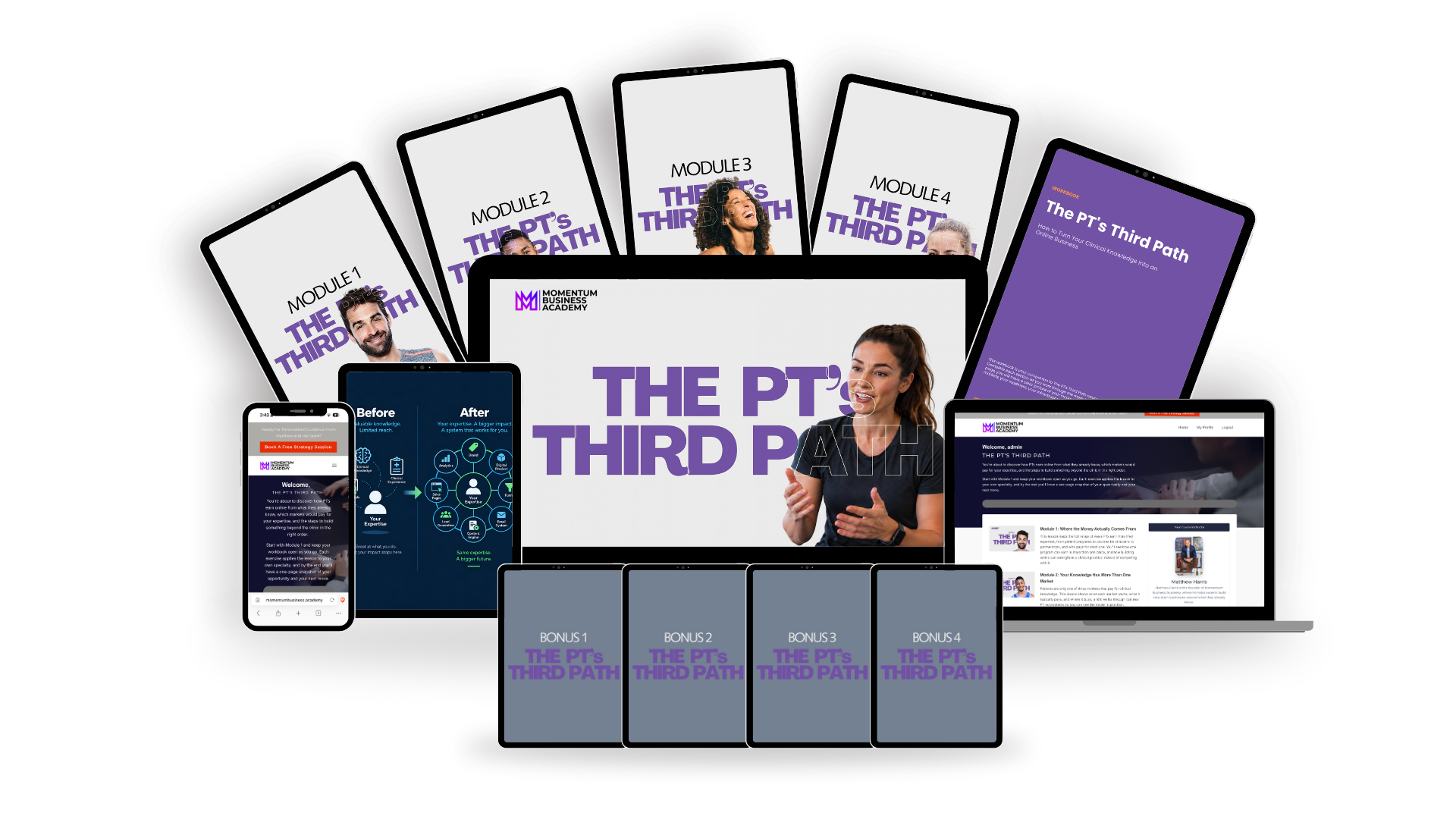
You'll Discover How To:
Here’s What You Get:
Get Instant Access
Start today for just $97
100% Money Back Guarantee We're confident The PT's Third Path will change how you see your career, your expertise, and what's possible beyond patient hours. But if you go through the course and don't walk away with a clearer picture of your opportunity, simply email us within 30 days for a full refund. No hassle, no questions.
Is This Course for You?
THIS IS FOR YOU IF...
THIS IS NOT FOR YOU IF...
You Know More Every Year, and Your Paycheck Hasn't Noticed
If this sounds familiar, you're not imagining things.
You've spent years getting better at this, through the doctorate, the certifications, and the weekend courses you paid for out of your own pocket because you wanted to be good. It worked. You catch things in an eval now that you'd have missed five years ago, and your patients and colleagues notice even when nobody says so. Your paycheck is the one thing that hasn't moved much.
The numbers behind that aren't subtle. The median PT salary sits around $102K* while average student debt is around $142K**, which can stretch repayment out to 16 years. Reimbursement isn't rising to meet you, and the notes still follow you home at night. Meanwhile, the advice you keep hearing is to work more hours, which is a hard suggestion to take when you're already finishing documentation after dinner.
What makes it strange is that demand for what you know has never been higher. Every person has a body that gets injured, ages, recovers from surgery, carries a pregnancy, and occasionally runs a marathon it probably shouldn't have.
You understand those problems better than almost anyone. So why does your income stop exactly where your calendar does?
* Bureau of Labor Statistics, U.S. Department of Labor, Occupational Outlook Handbook, Physical Therapists, at https://www.bls.gov/ooh/healthcare/physical-therapists.htm
**American Physical Therapy Association https://www.apta.org/contentassets/ee2d1bb7f9d841c983d0f21bb076bb79/impact-of-student-debt-report.pdf
Why Working More Stops Working
Most PTs are offered the same few options, and each one is legitimate right up until it runs into the same limit.
More clinical hours.
Plenty of PTs pick up weekend PRN shifts or move to a clinic that pays a few thousand more, and it does help. The trouble is that every extra dollar still depends on another hour of you in the room, so the ceiling rises a little each time without ever really going away.
Learn more.
A residency or fellowship will make you a better clinician, and that matters for your patients. Inside the same pay model, though, knowing more rarely turns into earning proportionally more, because you're still paid for visits rather than just for what you know.
Build a practice.
Hiring clinicians and adding locations can raise the income ceiling, and some PTs love running that kind of business. It also brings payroll, overhead, and a calendar full of management, which is how plenty of owners end up trading clinical burnout for the administrative kind.
None of these paths are wrong, but they all run on your hours, so sooner or later they all hit the same wall. The more useful question is whether what you know could reach people without needing another treatment hour to get there.
What I Kept Seeing Over Years of Helping Clinicians Build Online
I'm not a PT, which turned out to be part
of why I could see it.
I'm Matthew Harris, and I should say up front that I've never treated a patient, so I won't pretend to know what your day feels like from the inside. What I have done is spend the last 15+ years in online marketing and generated north of $40 million in online sales. That work taught me what it actually takes to put the right offer in front of the right people, and how rarely a good product sells on its own.
Over the last several years, I've brought that experience into healthcare education, building marketing campaigns and systems for higher ed rehabilitation sciences programs, continuing education providers, and clinicians with education businesses of their own.
A lot of PTs assume the clinicians selling programs and courses online are a different kind of expert, the ones with a big name, a fellowship, or years on the conference circuit, and that everyone else is meant to stay in the clinic. I understand why it looks that way, but that's not the full story.
I've often asked clinicians how they explain a problem to a new patient. Most of them walk me through it without a second thought, using an explanation they've polished over hundreds of visits because it's the one patients understand. Partway through, a lot of them stop and say some version of the same thing, that they've been educating patients for years without ever calling themselves "teachers."
The PTs who had taken that knowledge online weren't a special group. I watched clinicians build exercise programs that patients they'd never meet followed at home, and others record courses that PTs across the country took from their living rooms. Some of them were exceptional clinicians. Others, honestly, knew no more than the PT down the hall who had never built anything at all.
What set them apart was that they'd been willing to put what they knew out there, and they had a way for it to reach people beyond the treatment room. Once it did, what they earned no longer rose and fell with the number of patients they could see in a week. Meanwhile, some of the most skilled PTs I've talked with are the ones whose expertise travels the shortest distance, from their own head to the one patient on the table in front of them.
Your Income Ceiling Isn't Your Knowledge.
It's Your Reach.
Right now, everything you know reaches people through a single channel, which is you, in the room, with one patient at a time.
There are two kinds of value in your work, and only one of them is capped.
Clinical labor is you treating patients, and it will always be limited by the hours in your schedule. Clinical knowledge is everything you bring into those hours, and much of it can be taught to people you'll never personally treat.
For patients and the public, that usually means the exercises you prescribe every week: the progressions you've refined, the cues that get the movement right, the modifications when something flares, and the program that gets someone back to running or lifting their grandkids. For other clinicians, it's the part they can't get from a textbook, like how you reason through a complicated case or the patterns you catch in the first 30 seconds of an eval.
Packaging what you know doesn't mean starting a new career. It gives the expertise you already have more than one way to reach people, and more than one way to earn, whether you keep treating full-time or eventually cut back. For PTs who stay in the clinic, the clinical side often gets stronger in the process, since a visible expert tends to get better referrals and a more selective caseload.
It also doesn't require you to become a marketer. What it does require is knowing what to build, who it's for, and what has to exist around it so the right people can find it.
Now You Might Be Thinking...
"Plenty of PTs post online every day, and most of them aren't making money from it."
That's true, I noticed that too! And alot of times the content is actually good and the expertise behind it is real. Content creation is one of the best ways to build an audience, and for some PTs it even becomes an income stream of its own. But why does that happen for only a few PT's?
What's missing is everything around the posts, such as a defined market, an offer built for that market's problem, evidence that people want it, and a clear path from watching a video to buying something from that PT. Without that infrastructure, a growing follower count has nowhere to go. That's why in The PT's Third Path I walk you through the entire ecosystem you need around your expertise online, so what you create and share can actually lead to generating an income.
"I don't know anything other PTs don't already know."
The better you know something, the more obvious it feels, which is why this reaction tends to show up in people with real expertise. It also measures you against the wrong group. Most of the people who could buy from you are patients and the public, like runners with cranky knees, new moms easing back into exercise, and adult children worried about a parent's balance. Next to them, the home program you'd write without thinking is knowledge they can't get anywhere else.
Even among clinicians, the progressions you trust and the way you explain a diagnosis took thousands of patient conversations to build, while a new grad has had a few dozen. In The PT's Third Path we discuss these Expertise Blind Spots, and the Clinical Knowledge Inventory helps you write down what you've stopped noticing, and then the Five Readiness Signals help you judge whether it's ready to build around.
"Nobody knows who I am, and I don't have time to learn marketing."
You will need an audience, but it doesn't have to be as big as you might think. A few hundred of the right people, such as patients with the problem you treat best or PTs who want to learn how you handle it, will often buy faster than thousands of casual followers. Bonus 2 shows you how to build that Minimum Viable Audience, starting with the people who already know your work.
Building an online business around your expertise also requires marketing to happen, but it doesn't require you to do all of it yourself. In The PT's Third Path, you'll learn how to separate the work only you can do from the work someone else can build from what you know.
Everything Inside The PT's Third Path
Four core lessons and four bonus lessons, plus one workbook that turns what you learn into your own customized opportunity roadmap.
Module 1 ($47 value)
Where the Money Actually Comes From
Module 2 ($47 value)
Your Knowledge Has More Than One Market
Module 3 ($47 value)
Are You Ready To Build Around Your Expertise
Module 4 ($47 value)
Why a Course Is Not a Business
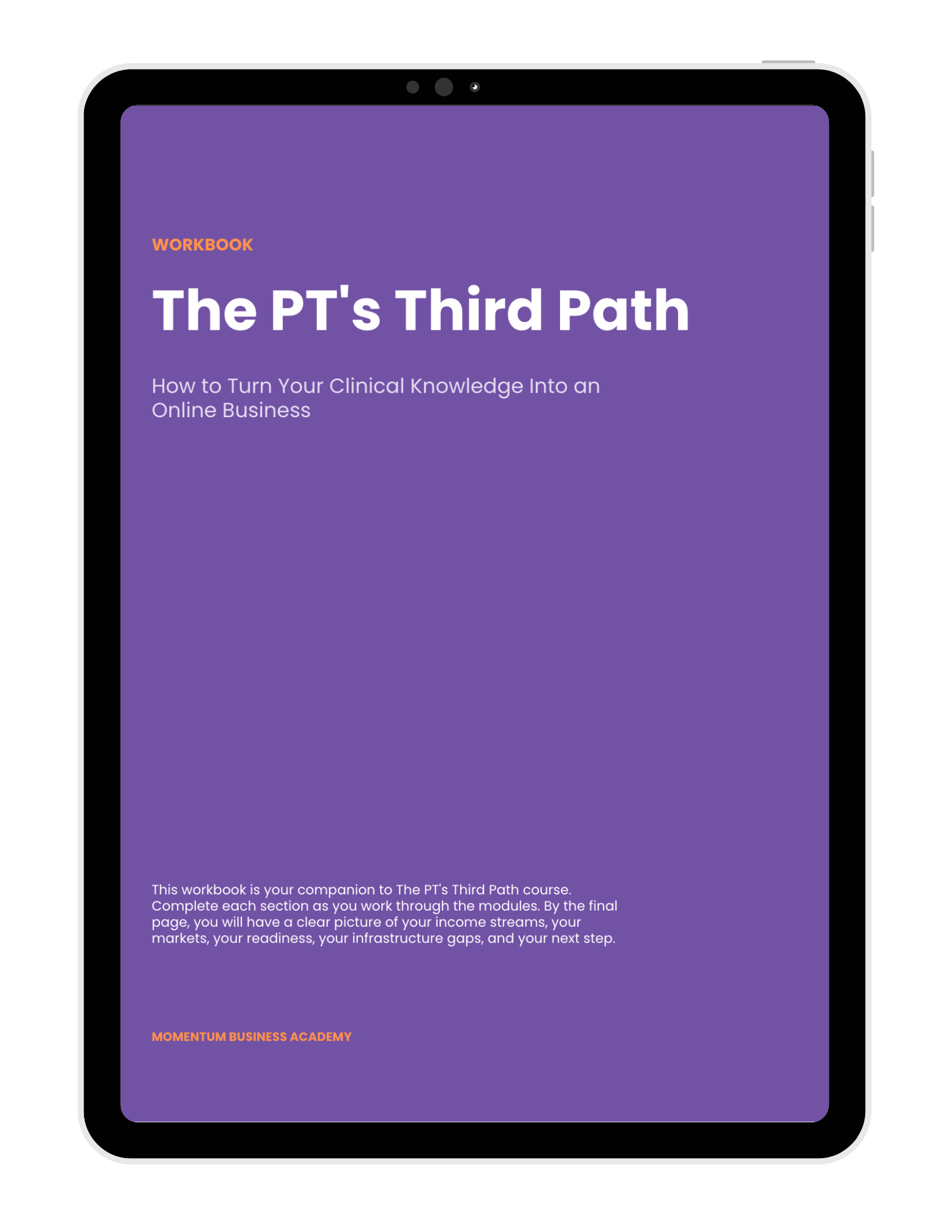
The PT's Third Path Workbook
($97 value)
Going through a course can leave you with good ideas and no idea what to do with them. The workbook is what keeps that from happening. Each exercise takes a lesson and applies it to your specialty, your patients, and your schedule, so you're working through your own situation the whole way instead of just learning concepts.
For a limited time
Enjoy These Exclusive Bonus Modules
If part of you is convinced you don't have anything unique to offer, this lesson is for you. Much of what makes you good at your job has become so automatic that you don't recognize it as expertise anymore. That's exactly what patients and other clinicians would pay to learn. You'll find out where that hidden expertise tends to show up, how to tell real expertise from "common knowledge," and why you don't need your own named method before you start.
It's easy to look at PTs with huge online followings and assume that's the price of entry. The reality is that a small group of the right people will often buy faster than a big crowd of casual followers. This lesson walks through the audience models that work, the one income stream where a large following really does help, and why your first customers may be people who already know your work. If you enjoy creating content, you'll see where it fits too.
You went to school to treat patients, not to learn ad platforms, funnel tools, and email software. The good news is that building around your expertise doesn't require you to do every part of it yourself. This lesson separates the work only you can do from the work someone else can build from what you know. It also gives you an honest look at how much time each approach really takes, so you can decide how involved you want to be.
The most common mistake is also the most expensive one: spending months recording a course before anyone has said they want it. This lesson walks through the order that protects you from that, so you know who your buyer is and what they'll pay for before you build anything. It finishes with eight first offers that aren't a course at all, several of which you could test in weeks instead of months.
Total Value: $533
Today Just - $97
Three Paths, and the Choice Is Yours
What if your income didn't have to rise and fall with the number of patients on your schedule?
What if the expertise you've spent years building could reach people you'll never treat, and earn from them too?
What if you could stay in the clinic, cut back, or step away on your own timeline, because what you know was working for you in more than one place?
What if the next time someone asked what you can do with a PT degree, you had an answer that had nothing to do with seeing more patients?
That's what the third path is for. The first two will always be there, but this is the one that's uniquely yours.
Frequently Asked Questions
Is this a business-in-a-box or a done-for-you system?
No. The PT's Third Path is a self-paced onine training course that guides you through understanding how to monetize your clinical knowledge online. It shows you the model, the markets, the revenue pathways, and what infrastructure would need to exist.
Will this course make me money?
Not on its own, so I won't promise that it will. What it gives you is clarity about where your knowledge could earn, who would pay, whether you're ready, and what would have to exist to make it work. What you do with that is up to you.
What about my employer or my license?
It's a good thing to ask about. The course draws a clear line between individualized clinical care, which can fall under licensure, scope-of-practice, and telehealth rules, and education, which can often reach much broader audiences. It also encourages you to confirm what applies to your situation and to check your employment agreement, since the course isn't legal advice.
I already tried creating a course, and it didn't work. Is this for me?
Yes, and Module 4 and Bonus 4 were written with you in mind. When a course launches to silence, the content is rarely what went wrong. More often it was built before anyone confirmed who would buy it or how they'd find it, and that kind of sequencing problem is something you can fix on the next attempt.
I'm not sure I'm ready to build something yet. Is this still worth it?
You are exactly who this program was built for. In particular, Module 3 guides you through a readiness assessment that helps you figure out where you actually stand. You may be closer than you think, or you may need a few things in place first. Either way, you'll know and the program guides you with next steps.
Is this only for physical therapists?
The course was created specifically for licensed PTs and PTAs. The examples, language, pain points, and frameworks are all built around the PT profession. If you're not a PT, the model may very likely still apply, but the content was not designed for other professions.
Copyright © 2026 | Momentum Business Academy, LLC. All Rights Reserved.